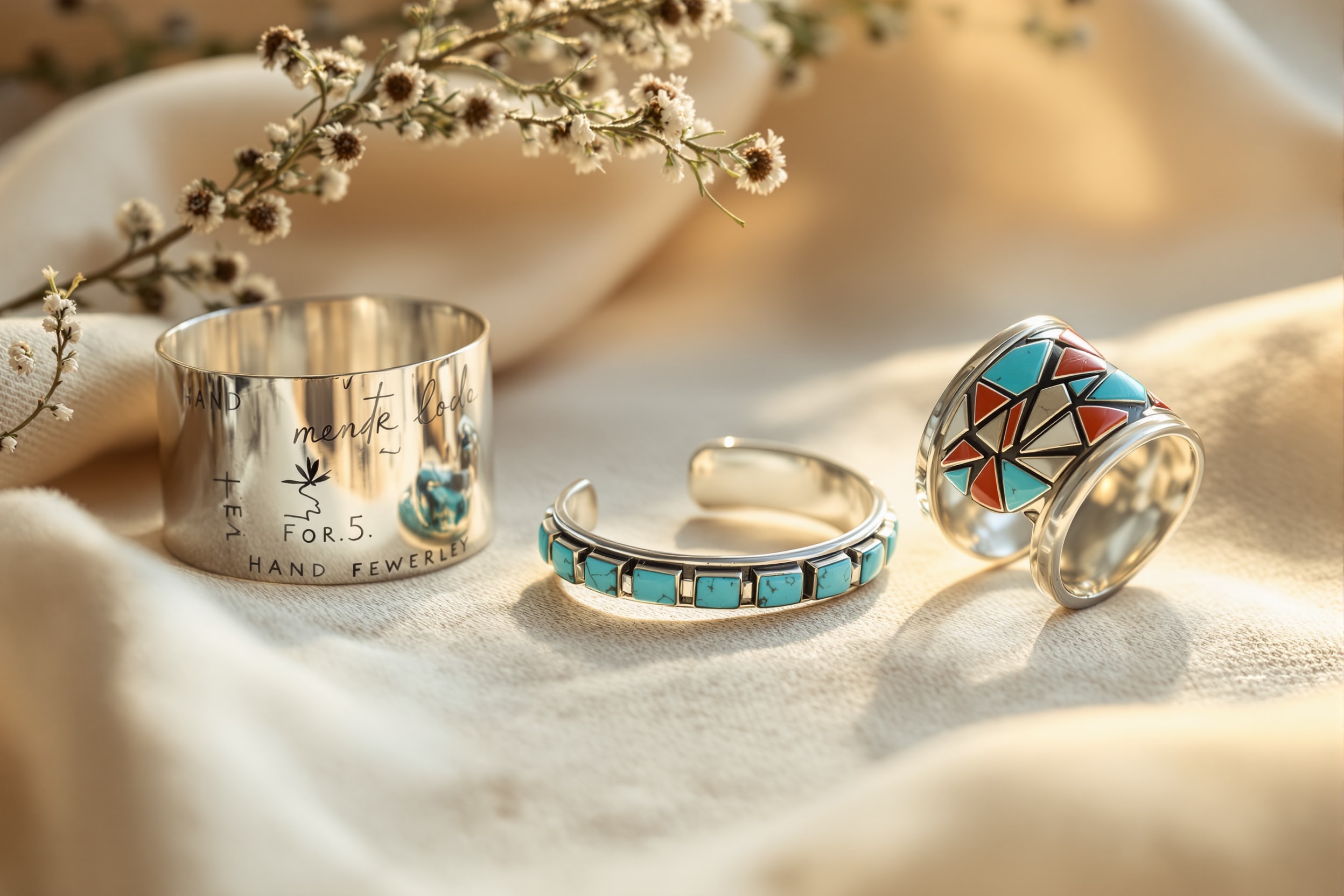
The bracelet may be the most personal form of Southwestern jewelry — worn daily, handed down, and shaped over time to the wrist that wears it. Across the nations, the bracelet is where a smith's stamping and a lapidary's stone-setting meet. This guide surveys the major forms.
The Silver Cuff
The open cuff is the foundation. A single band of hand-worked silver — stamped, filed, twisted, or left boldly plain — the cuff can stand entirely on its own or serve as the stage for turquoise. Navajo (Diné) smiths are especially known for heavy, sculptural cuffs whose silver carries deep repoussé and stamp work, sometimes with a single commanding stone at the center.
Row and Cluster Bracelets
When many stones join the design, two classic patterns appear. A row bracelet sets stones in a line along the band; a cluster bracelet gathers them around a central stone like petals around a flower. Zuni artists refine these into needlepoint and petit point — dozens of tiny, precisely cut turquoise or coral stones arranged with astonishing regularity. These are patient bracelets, counted in hours per stone.
Inlay Bracelets
Inlay lays flat stones edge to edge into a smooth mosaic surface. In channel inlay, thin silver walls separate each stone; in mosaic inlay, the stones meet directly. Zuni and Hopi artists compose inlay bracelets in turquoise, coral, jet, and shell, sometimes forming figures such as a sunface. The result is a band that reads almost like a painting in stone.
Sandcast and Ingot Work
Some of the most striking bracelets begin as molten silver poured into a carved tufa-stone mold. Sandcasting (more precisely, tufa casting) gives a soft, organic surface impossible to achieve by stamping alone, and each mold can be used only a few times — so every casting is nearly unique. Ingot silver, hand-rolled from a poured bar, gives older and revival pieces their dense, satisfying weight.
A Wrist With History
The bracelet has a special place in Southwestern life. In the trading-post era of the early twentieth century, silver bracelets were made both to wear and to pawn — a portable savings that could be redeemed when times improved — and "old pawn" pieces are prized today for exactly that hard-worn authenticity. A cuff worn for decades takes on a soft patina and molds subtly to its wearer, so that an old bracelet carries not only its maker's hand but its owner's life. This is jewelry meant to be lived in, not locked away.
Choosing a Bracelet
A cuff should fit the wrist with a comfortable gap and adjust only gently and rarely — repeated bending fatigues silver. Consider the stone's origin, look for the maker's hallmark, and buy from sources that can name the artist and nation; the Indian Arts and Crafts Act protects your right to genuine work. For the broader story of the metal and stone, see our overview of turquoise and silver, and the collections of the National Museum of the American Indian for masterworks in context.