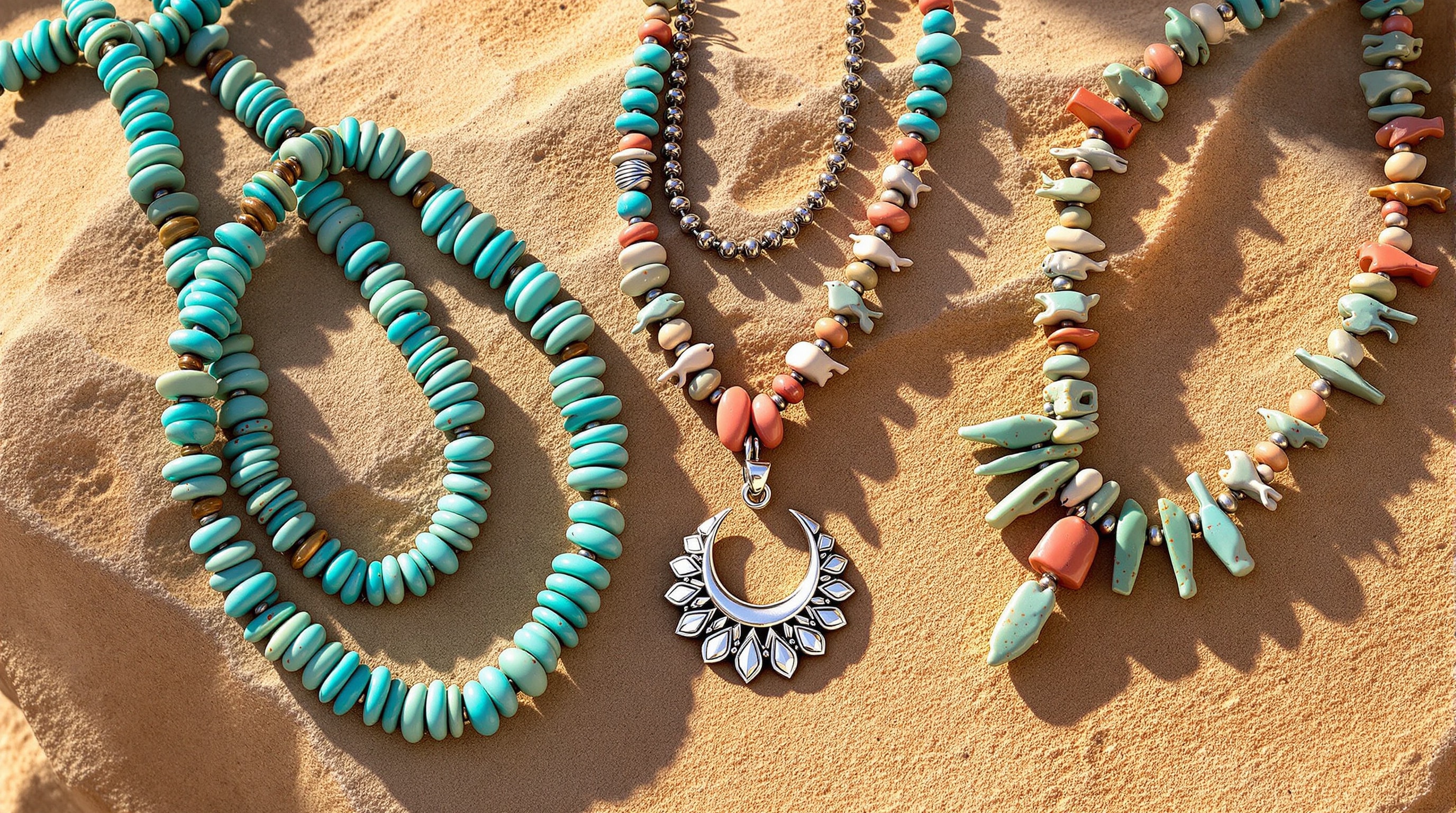
Worn close to the heart, the necklace holds a special place in Native American adornment. Its forms range from the humblest strand of hand-ground beads to the grand silver crescent of the squash blossom — and each carries its own history. This guide surveys the great necklace traditions.
Heishi — The Oldest Beads
Heishi (pronounced "hee-shee") are small disc beads ground from shell or stone and strung into supple, liquid strands. Among the oldest ornaments in the Americas, true heishi are still made largely by hand, and the people of Kewa Pueblo (Santo Domingo) are their acknowledged masters. A fine olive-shell or turquoise heishi strand, uniform and smooth, represents days of patient rolling and grinding — the quiet virtuosity behind our overview of the nations.
The Squash Blossom Necklace
The most iconic silver necklace of the Southwest, the squash blossom, unites three elements: round silver beads, "blossom" beads flowering along the strand, and a central crescent pendant called the naja. The naja's crescent form traces back through Spanish-Moorish horse ornaments — a reminder of how Native artists absorbed new influences and made them wholly their own. Set with turquoise or left in bold plain silver, the squash blossom remains a masterpiece of the Diné silversmith's art, described further in our turquoise and silver guide.
Fetish Necklaces
A fetish necklace strings many tiny carved animals — birds, bears, badgers, and more — along strands of heishi. Zuni carvers create these miniature menageries with remarkable delicacy, and a multi-strand fetish necklace can hold dozens of individually carved creatures. Beyond their beauty, the animals carry the meanings explored in our guide to understanding Zuni fetishes.
Beadwork and Beyond
Away from the Southwest, glass-bead necklaces flourish among Plains and Woodlands nations, worked in loom and applique techniques into medallions and chokers of dazzling color. Coral, spiny oyster, and turquoise nuggets also appear in nugget necklaces and multi-strand designs. Each region's palette and pattern reflect its own aesthetic, a diversity celebrated on our Plains Nations art page.
Length, Layering, and Meaning
Necklace length is part of the design. A short jacla or choker sits high at the throat; a squash blossom falls dramatically over the chest; multi-strand heishi and fetish necklaces are often meant to be layered, their strands counted as a measure of the maker's labor and the wearer's regard. In many communities certain necklaces are worn for ceremony and dance, others for every day, and the choice carries quiet meaning. When you select a necklace, consider not only the stones but how it will sit and move — these are pieces designed for the living body, not the display case alone.
Wearing and Keeping
Store necklaces flat to protect the stringing, keep heishi and turquoise away from perfume and lotion, and have well-loved strands restrung when needed. When buying, ask the maker's name and nation and choose sources that support Native artists — the Indian Arts and Crafts Board offers a buyer's guide. Museums such as the Wheelwright Museum display historic and contemporary necklaces that reward close study.