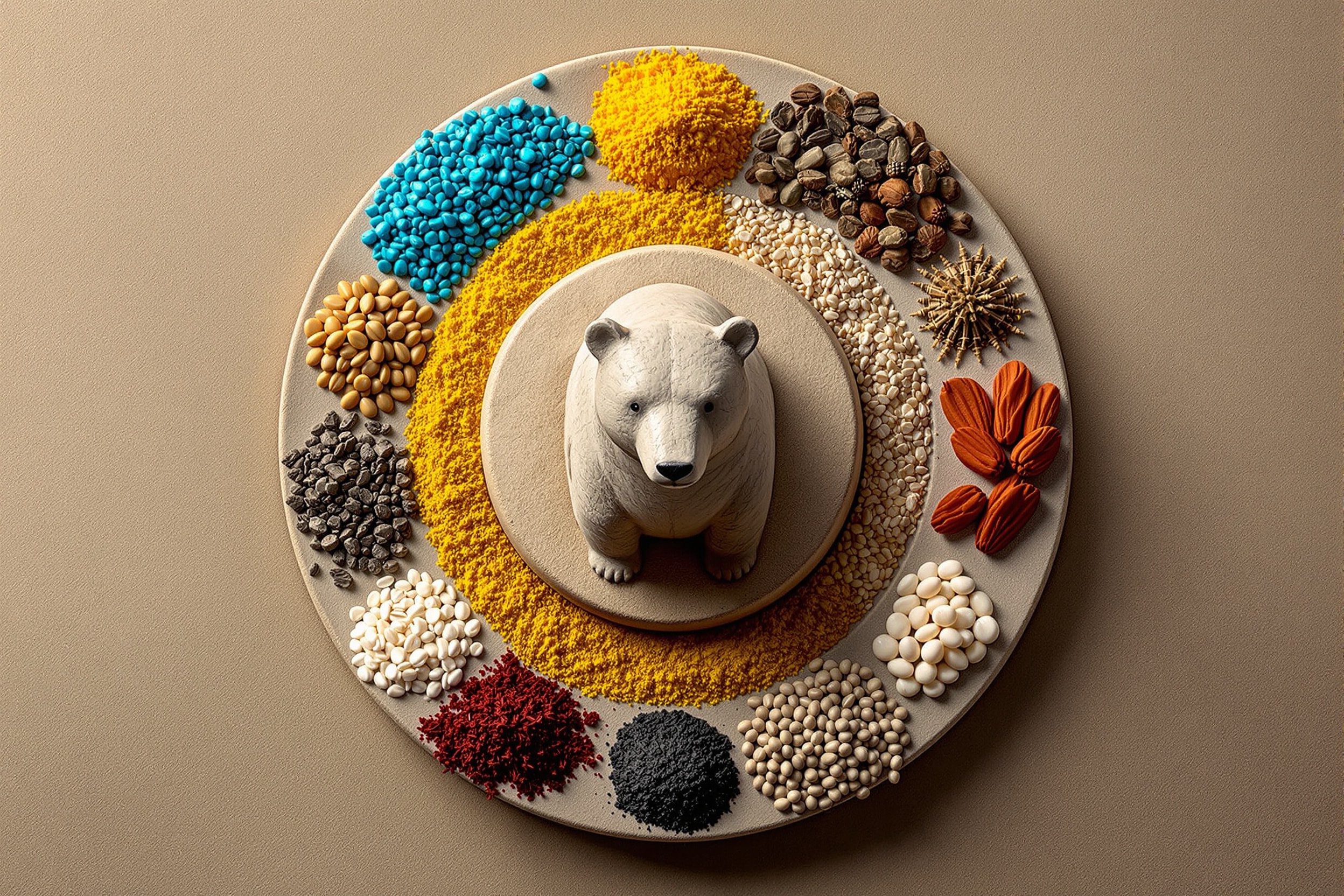
To collect or admire a Zuni fetish carving is to encounter a small piece of a large cosmology. The carved animal is beautiful, but its beauty rests on meaning. This guide offers a detailed explanation of that meaning: the theories behind Zuni fetishism, and the six directions with their guardian animals.
Six Theories, One Practice
The Zuni people incorporate six ideas into their religious life: animism, totemism, causality, ancestor veneration, fear, and fetishism. Where many tribal societies adopt two or three such ideas and weave them into a central belief, the Zuni have, for generations, successfully carried all six within a single practice. Fetishism, strictly defined, is the honoring of spirits that reside within material objects; it also involves causality, which orders the fetishes into a hierarchy.
That hierarchy is based on a being's degree of dependency and its air of mystery. By this measure man — the most dependent and least mysterious — stands lowest, farthest from the deities. To reach the deities, a person calls on those above him as a conduit. Animals stand closer to the divine: mortal like us, yet more mysterious, and possessed of powers we lack. Tellingly, the better understood an animal is, the lower its standing — a domestic pet ranks beneath its wild relatives.
The Guardians of the Six Directions
Fetishes serve many purposes, but the fetishes of prey are the best known. According to Zuni legend, Po'-shai-an K'ia, father of the sacred bands, was surrounded by six warriors for protection, and he appointed each to guard one of the six regions of the earth. Every living thing within a region falls under its guardian's care.
- North — the Mountain Lion (Long Tail). Master of the gods of prey, stout-hearted and strong-willed, named Maker of Paths of men's lives. His color is yellow, the color of his coat.
- West — the Black Bear (Clumsy Foot). His coat is the color of night; his color is the blue of the Pacific. He is revered for strong healing powers and for his ability to protect and provide.
- South — the Badger (Black Marked Face). His color is the red of the distant mountains. He is honored for perseverance in the face of adversity.
- East — the Wolf (Hang Tail). His color is the white of daylight. Fiercely loyal, he possesses the cunning to fend off one's enemies.
- The Lower Region — the Mole. Master of the world below, his color is black. His burrowing shows flexibility and fidelity: he can change direction in an instant to avoid danger, and his tunnels become traps for his predators.
- The Upper Region — the Eagle (White Cap). Guardian of the sky, he represents all colors and is said to be indefatigable, tirelessly circling his domain to preserve its openness. He is the symbol of free-spiritedness.
Why the Carving Matters
The Zuni believe that a carved effigy embodies the same traits and powers as the living animal, and can lend those qualities to its keeper — provided the likeness is well cared for by the one who bears it. A bear carving, then, is not a figurine of a bear; it is an invitation to the bear's healing spirit. This is why traditional carvings often carry an offering bundle tied to the back, a gift to keep the spirit content.
Bringing Meaning Home
When you hold a fetish, ask what the animal stands for and what you are asking of it. Choosing a mountain lion for resolve, a bear for healing, or an eagle for freedom turns a carving from an ornament into a companion. To learn how these meanings are given form in stone, return to our page on the art of Zuni fetish carving, and explore the broader cultures behind the tradition on our nations overview. For scholarly grounding, the Smithsonian National Museum of the American Indian is an excellent starting point.