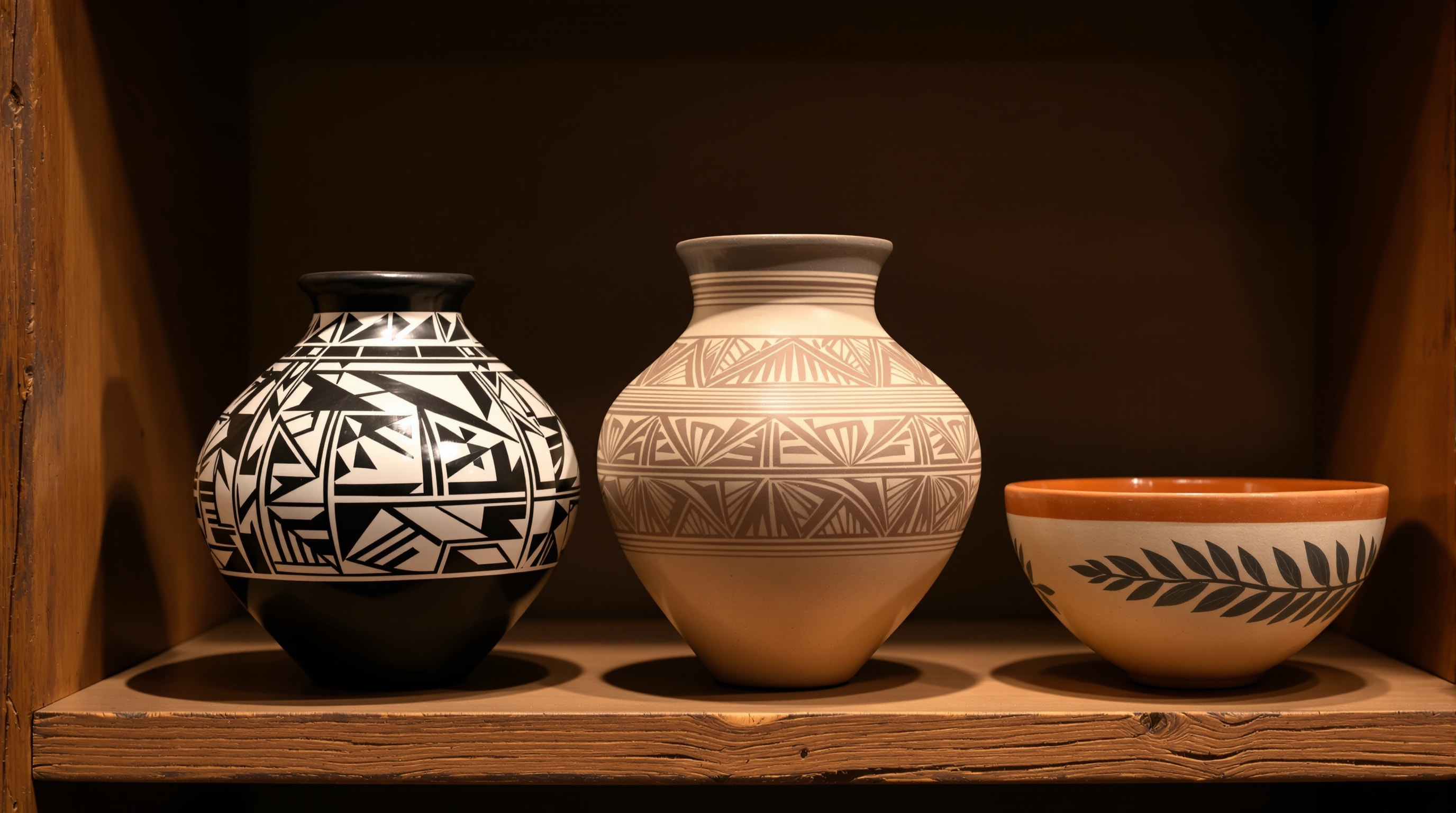
Pottery is among the oldest and most eloquent of Pueblo arts. Built entirely by hand from local clay and painted with pigments gathered from the earth, a fine Pueblo pot is a small monument to place — and to the generations of potters, most of them women, who have kept the tradition alive. This guide introduces how the work is made and how to recognize the great pottery nations.
Built by Hand, Fired by Fire
Traditional Pueblo pottery uses no wheel. The potter digs and processes clay, then builds the vessel by coiling ropes of clay upward and scraping them smooth. A fine clay slip is polished onto the surface, designs are painted with yucca-leaf brushes using mineral and plant pigments, and the pot is fired outdoors — historically in a dung-fueled fire whose atmosphere can turn a vessel red, white, or black. Every step is done by hand, which is why no two traditional pots are ever truly identical.
Zuni Pottery
Zuni potters are known for crisp designs in black and red on a white slip. Two motifs are signatures: the rainbird, a stylized bird-and-scroll pattern, and the deer with a heartline — a deer shown with an arrow running from mouth to heart, representing the breath of life. Zuni jars and the beloved Zuni owl figures are prized by collectors worldwide.
Acoma Pottery
From Acoma, the ancient "Sky City" mesa, come some of the thinnest-walled pottery in the world. Acoma potters paint dense, precise fine-line geometric patterns and revived the ancient Mimbres animal designs, all in mineral paints on a bright white slip. Tapped gently, a true thin-walled Acoma pot gives an almost bell-like ring.
Hopi Pottery
Hopi pottery is famous for the Sikyatki Revival, sparked at the turn of the twentieth century by the celebrated potter Nampeyo, who drew inspiration from ancestral shards to create warm, cream-and-orange vessels with flowing avian and feather motifs. Hopi pottery often needs no painted slip at all — the fired clay itself provides the golden ground.
Kewa (Santo Domingo) Pottery
The potters of Kewa Pueblo produce bold, graphic pottery in black-on-cream and black-on-red, favoring strong floral and geometric designs. The same community that leads in heishi and necklaces brings a confident, large-scale hand to its ceramics.
Reading the Designs
Pueblo pottery designs are a language. A band left deliberately unclosed is a ceremonial line-break or "spirit line," a gap in an otherwise continuous border that many potters include with intention. Motifs carry meaning too: water and cloud symbols call to the rain that a desert people depend on; the rainbird and stepped-cloud patterns recur across pueblos with local variations; and the deer's heartline speaks of the breath of life — the same idea found in the offering bundles of Zuni carving. Learning to read these elements turns a beautiful pot into a legible one, and deepens respect for the potter's choices.
Collecting Pueblo Pottery
Look for hand-coiled construction, natural firing marks (often a badge of authenticity rather than a flaw), and the potter's signature on the base — most contemporary Pueblo potters sign their work. Ask which pueblo and which family a pot comes from, and buy from sources that support the potters; the Indian Arts and Crafts Board can guide you. For deep study, the Museum of Northern Arizona and the Heard Museum hold outstanding pottery collections.