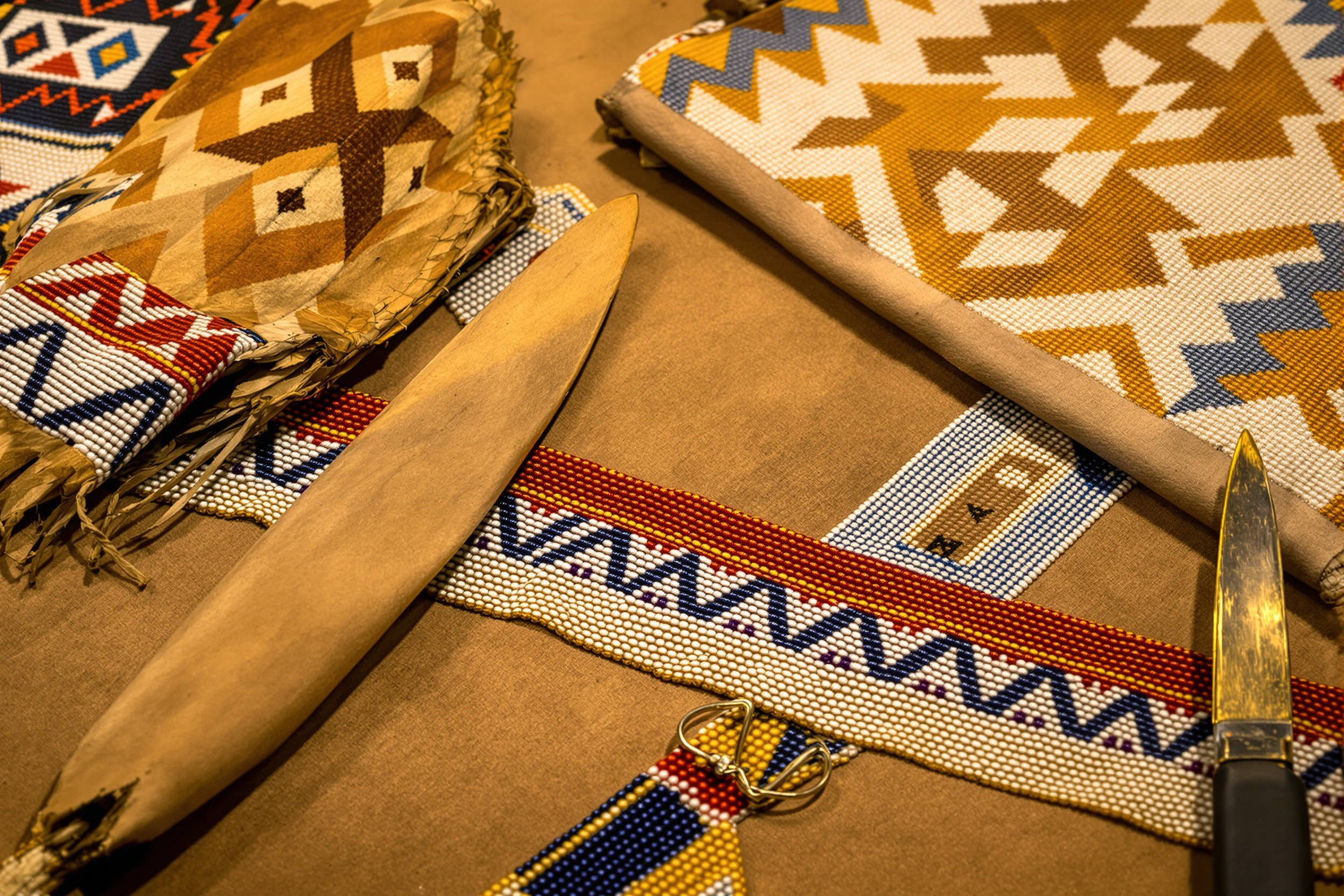
Where the Southwest speaks in stone and silver, the Great Plains speak in color, line, and story. The nations of the Plains — among them the Cheyenne and Arapaho — developed art forms suited to a mobile life: portable, wearable, and richly meaningful. This guide surveys their major traditions, from quillwork to the narrative art of the ledger book.
Quillwork — Before the Bead
Long before trade beads arrived, Plains artists decorated hide with dyed porcupine quills, flattened and folded into geometric bands of astonishing precision. Quillwork was a respected and even sacred art, and its patterns laid the groundwork for the beadwork that followed. Fine quillwork is still practiced today as a mark of the highest skill.
Beadwork — A Signature in Glass
With the arrival of small glass "seed beads" in the nineteenth century, Plains women created an explosion of beadwork: moccasins, cradles, dresses, and pipe bags covered in bold geometric and floral designs. The Cheyenne and Arapaho favored strong, clean geometry in the "lazy stitch" technique, building fields of color into patterns as distinctive as any signature. Beadwork remains a living art, worn with pride at powwows and passed carefully between generations.
Painted Hides and Parfleche
Plains peoples painted directly on hide. The parfleche — a folded rawhide envelope for storing food and belongings — was painted with brilliant geometric designs, while robes and tipi liners could carry painted records of events and honors. Men traditionally painted the representational and narrative images; women painted the geometric. Both were forms of visual language as much as decoration.
The Shield and Its Imagery
A warrior's shield was among the most powerful of possessions, its painted imagery believed to carry spiritual protection revealed in vision. Because that imagery was sacred and personal, shields were treated with great care; today their designs are studied as a profound expression of Plains cosmology, best understood through the interpretation of the communities themselves.
Ledger Art — Story on Paper
When the buffalo hide grew scarce in the late nineteenth century, Plains artists adapted, drawing their narrative scenes in the pages of accountants' ledger books. Ledger art preserved histories of hunts, ceremonies, and battles in vivid colored pencil and ink, and it endured even through imprisonment and hardship. Far from a relic, ledger art thrives today as a celebrated contemporary form, carrying the Plains storytelling tradition into museum galleries around the world.
A Continuing Tradition
None of this is confined to the past. Contemporary Plains artists continue every one of these forms — beadworkers dress dancers for powwows across the continent, quillworkers pass their exacting craft to new apprentices, and a celebrated generation of contemporary ledger artists draws on antique ledger pages and modern paper alike to tell Native stories on Native terms. Plains art today moves fluidly between the community and the museum gallery, honoring inherited technique while speaking to the present. To collect or study it is to engage with a living culture, not a closed chapter.
A Living History
The art of the Plains is inseparable from the resilience of its peoples. The Cheyenne and Arapaho endured the 1864 Sand Creek Massacre — now a National Historic Site — and carried their traditions forward unbroken. To see masterworks of Plains art and read the histories behind them, the Smithsonian National Museum of the American Indian is an essential resource. Return to our overview of the nations to place the Plains within the wider world of Native art.