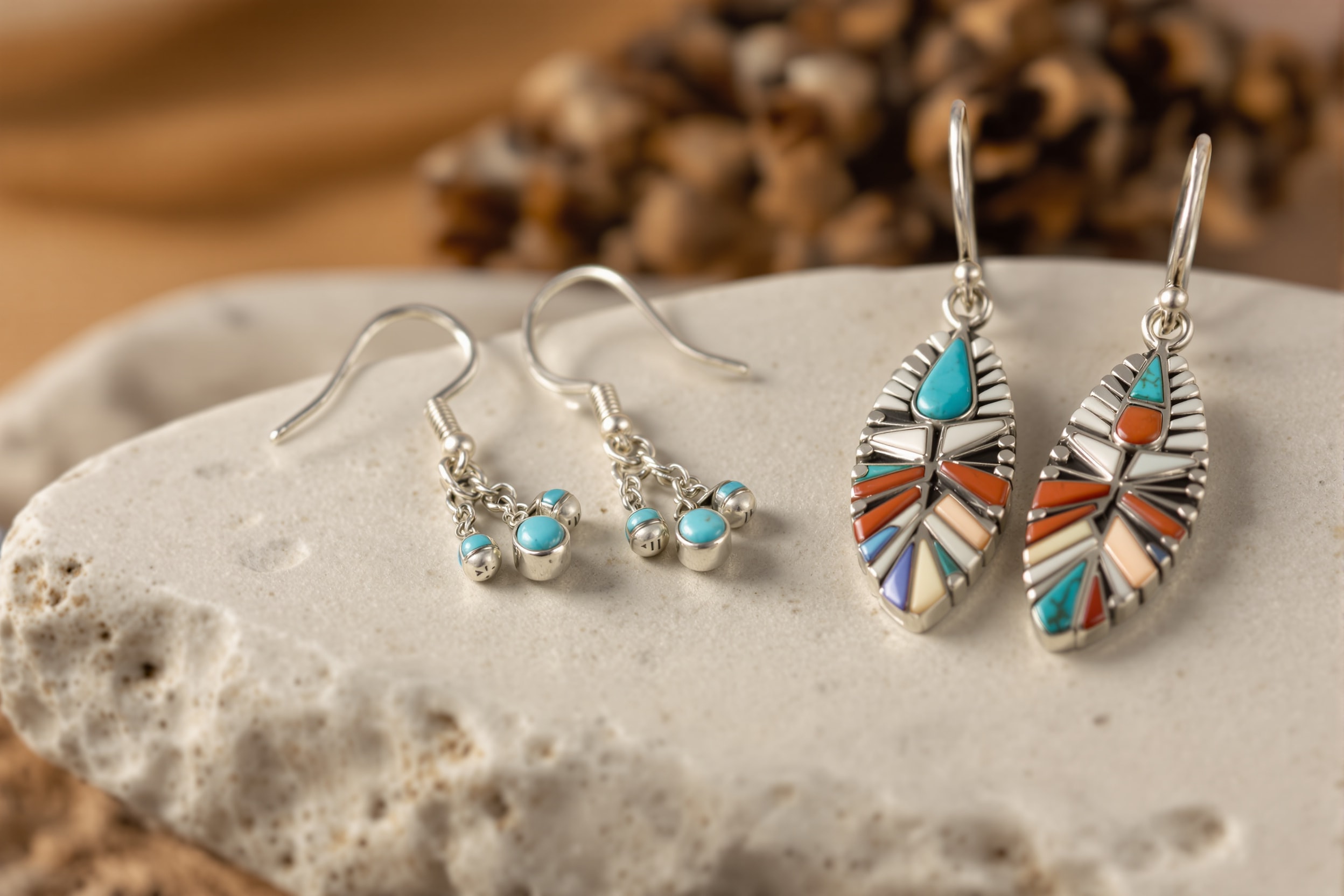
Earrings are small canvases, and Native artists have filled them for centuries — from the oldest turquoise drops to the finest modern inlay. Because a pair must balance, hang, and catch the light, earrings reward a jeweler's precision as much as any larger piece. This guide covers the main styles.
The Jacla — An Ancient Form
Long before silver, there were jaclas: small loops of turquoise or shell heishi worn in the ear or as a necklace pendant. The jacla is one of the oldest ornaments of the Southwest, and its simple cascade of tiny beads still appears in contemporary earrings, connecting a modern pair to a very old tradition. The Kewa (Santo Domingo) people are especially associated with these beadwork drops.
Silver Dangles and Hoops
With the arrival of silverwork, the dangle and the hoop joined the repertoire. Navajo smiths shape earrings with the same stamping, twisting, and repoussé they bring to bracelets, often suspending a turquoise drop below hand-worked silver. Hoops may be plain and elegant or textured with stamp work, and lightweight construction keeps even a substantial design comfortable to wear.
Zuni Inlay and Needlepoint Earrings
Zuni lapidary artistry shines at small scale. Needlepoint and petit point earrings set rows of slender or teardrop turquoise into delicate silver; channel inlay earrings compose turquoise, coral, jet, and shell into sunfaces, hummingbirds, and geometric mosaics. At this size the work is exacting, and a matched pair represents double the labor of a single ornament.
Materials and Meaning
Beyond turquoise, earrings showcase coral (warm reds and pinks), jet (deep black), spiny oyster shell (orange to purple), and mother-of-pearl (iridescent white). Colors are not chosen at random; many echo the palette of the six directions, and a thoughtful pair can carry quiet meaning as well as beauty.
Caring for Earrings
Because earrings are worn near the skin and the hair, they meet more oils, sprays, and cosmetics than most jewelry. Put earrings on last when dressing and take them off first at night; wipe silver gently with a soft cloth after wearing; and keep turquoise, coral, and shell away from perfume and lotion, which can dull or discolor porous stones over time. Store pairs together in a soft pouch or a lined box so that findings do not tangle and delicate inlay does not chip. A little routine care keeps a fine pair bright for generations.
Selecting a Pair
Check that the two earrings truly match, that findings are secure, and that the weight suits daily wear. As with all Native jewelry, ask who made the pair and from where, and favor sources that support the artists directly — the Indian Arts and Crafts Board can help you buy with confidence. To see how these same techniques scale up, visit our guides to bracelets and necklaces.