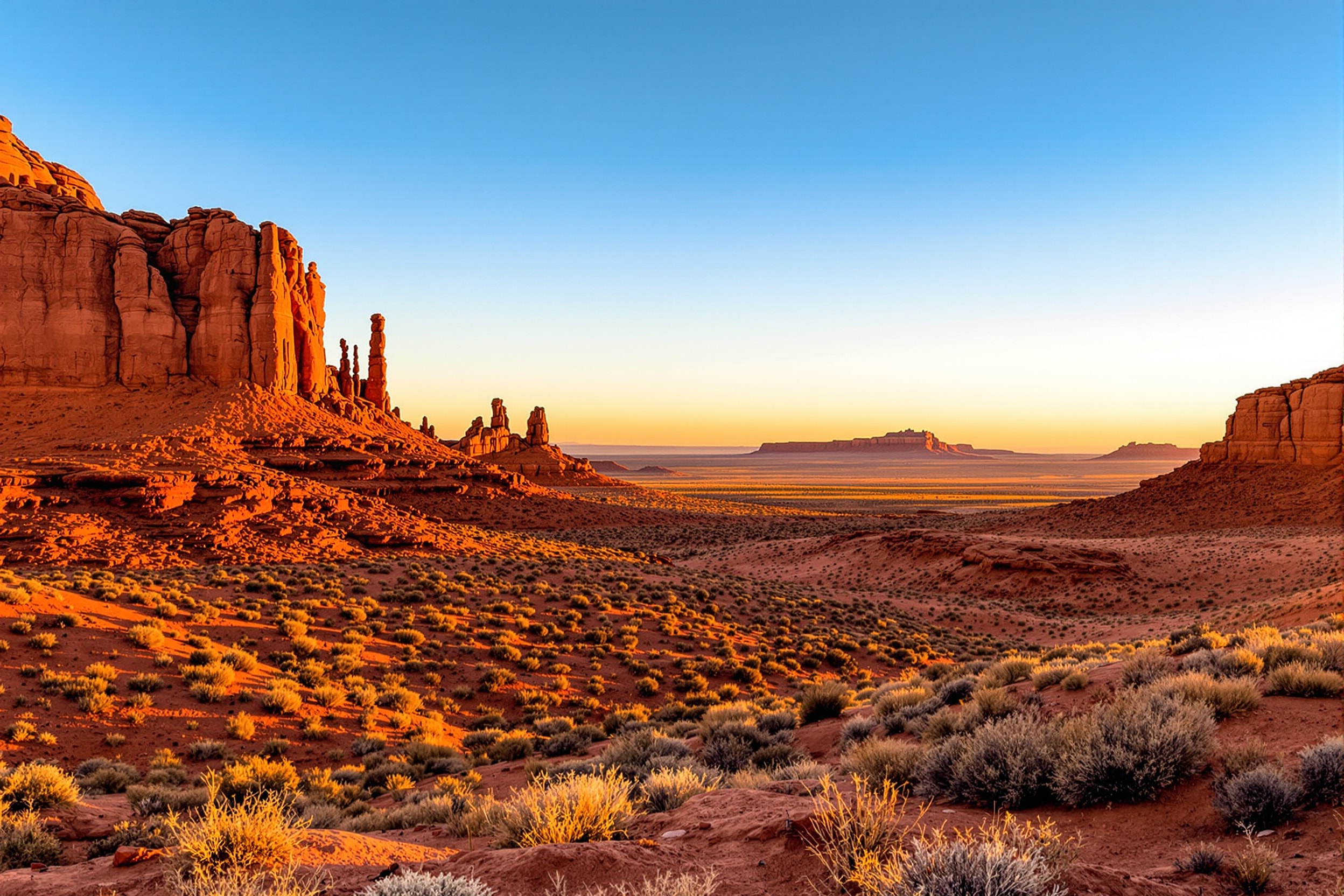
To understand Native American art you must first meet the peoples who make it. What is often flattened into a single label is in truth the work of many distinct nations, each with its own homeland, language, and artistic voice. This page introduces the nations most central to the Southwestern and Plains traditions covered throughout A Gallery of Nations.
The Zuni (A:shiwi)
The Zuni people call themselves the A:shiwi and have lived in western New Mexico since time immemorial, in a pueblo continuously occupied for many centuries. Zuni artists are renowned as master lapidaries and carvers. Their fetish carvings — small stone animals of prayer and protection — and their intricate inlay and needlepoint jewelry are among the most recognizable of all Native art. To learn more directly, the Pueblo of Zuni maintains its own cultural resources.
The Navajo (Diné)
The Diné, the largest tribal nation in the United States, hold a homeland spanning parts of Arizona, New Mexico, and Utah. Navajo smiths learned metalwork in the mid-nineteenth century and transformed it into a signature art: bold silver, the squash blossom necklace, the concha belt, and turquoise set in heavy, confident forms. Navajo weaving is a parallel tradition of world renown. The nation's artistry is a study in how a borrowed technique can become wholly one's own.
The Hopi
The Hopi of northern Arizona are celebrated for pottery, overlay silverwork, and katsina carving. Hopi overlay jewelry — two layers of silver, the top cut away to reveal oxidized designs beneath — is instantly identifiable. In pottery, the Sikyatki Revival led by the potter Nampeyo at the turn of the twentieth century reawakened ancient forms and made Hopi ceramics famous worldwide. Read more on our Pueblo pottery page.
The Kewa (Santo Domingo)
The people of Kewa Pueblo (long known as Santo Domingo) are the acknowledged masters of heishi — the fine shell and stone disc beads that are among the oldest forms of adornment in the Americas. Kewa jaclas and heishi strands, rolled and ground by hand, set the standard by which all others are measured. Their work anchors our page on necklaces and beadwork.
The Cheyenne and Arapaho
On the Great Plains, the Cheyenne and Arapaho developed a brilliant tradition of beadwork, quillwork, painted hides, and narrative art. Their history is also one of endurance: the Cheyenne and Arapaho people survived the 1864 Sand Creek Massacre, now preserved as a National Historic Site, and carried their artistic traditions forward into the present day. Their visual storytelling is explored on our Plains Nations art page.
Many Nations, One Respect
These are only a few of the peoples whose art the wider world admires; hundreds more each hold traditions of their own. The lesson of the nations is simple and important: when you look at a piece of Native American art, ask which nation, which community, and which maker. That question is itself a form of respect — and the beginning of real understanding. Institutions such as the Smithsonian National Museum of the American Indian can help you go further.